



Autumn gives you a new palette roughly every week. In early September the hedgerows are still green, just slightly tired at the edges. By late October they have gone from green to bronze to a bruised, bright red, and the pavements smell of leaf mould after rain. For anyone who makes things — writing, painting, songs, photographs, pots, quilts — this is the most generous season in the British calendar. It asks very little of you beyond going outside and paying attention.
The trick is to notice deliberately rather than vaguely. You do not need a national park, a decent camera or a free afternoon. A local park, a canal towpath, a footpath behind the houses and twenty minutes will do it. Here is how to make those walks feed your work.
Start With One Route, Walked Often
Novelty is overrated in autumn. Change happens so quickly that repetition teaches you more than exploration. Pick a single route you can walk in half an hour and go the same way two or three times a week, ideally at roughly the same time of day.
The first walk is for settling in. Leave the headphones off, put the phone in a pocket and let your pace drop a little. From the second walk onwards, choose three things to check on each time: a particular tree, a hedge, the state of the ground under your feet. A beech tree at the end of a road can go from green, to lime, to copper to bare in three weeks, and you will only really see it if you look at it repeatedly. Familiarity is what makes the small shifts visible.
Colour: Name What You Actually See
Most of us describe autumn in about four words: brown, orange, gold, red. That vocabulary is too blunt for the season. Walk with it for ten minutes and you will find that the hedge you called brown contains rust, oxblood, ash grey, straw, tea-with-too-much-milk and something close to the inside of a walnut shell.
Spindle is one of the best teachers here. Its leaves turn a soft, dusty pink while its berries split open into lurid orange seeds, and the combination looks almost wrong next to the muted hawthorn. Rowan berries are a flat scarlet. Sloes are blue-black with a bloom on them, like dust on a plum. Bracken goes the colour of old copper piping. Learn to describe colours by comparison rather than by name; comparisons are what you can actually use later.
The one-tree study
Choose a tree you pass often and study it properly for a fortnight. Note the colour of its leaves in sun and in shade, the colour of the trunk after rain, the shape of the shadow it throws at four in the afternoon. Between them, those notes will give you more usable detail than a whole afternoon of photographing everything you see.
Steal the palette
Collect fallen leaves, seed heads and a couple of berries, and tape them into a notebook or onto a piece of card. Take a photograph in shade rather than bright sun, because sun flattens colour into a high-contrast lie. A row of five leaves found on one walk makes a better reference sheet than anything you will find online, and it belongs to your particular street, in your particular light.
Texture: Look for the Second Layer
Once you have registered colour, move on to surface. Much of autumn's texture is small and close: lichen crusting an ash branch, the papery peel of silver birch, ash keys hanging in brown bunches, oak galls that look like little wooden apples, the dry rattle of teasels and the hooked grip of burdock burs.
Touch things, within reason. Compare a dry leaf in your hand with a soaked one from the gutter; run a thumb over moss after rain and then over moss after a dry week. Take a soft pencil and a scrap of thin paper and make rubbings of bark, gateposts, stone walls and manhole covers. It takes two minutes and gives you a set of textures you can hold up to the light later.
Be gentle with living things. Leave fungi where they are, don't peel bark off trees, and take photographs rather than specimens if you are unsure what you have found.
Sound: Build a Ten-Minute Recording
Autumn has a distinctive soundtrack and it is layered; the trick is to listen one layer at a time. Wind through beech hisses, through oak it rattles, through pine it sighs. Listen for:
- Leaves skittering along tarmac, and the softer sound of them moving through grass
- Acorns or conkers dropping onto a car roof, a path, a bin lid
- A robin singing again after its quiet moult, and the harsh scold of a jay
- Pink-footed geese arriving overhead, calling as they shift formation
- A stream running hard after a day of rain
- Rain on different surfaces: leaves, canvas, water, metal
Record sixty seconds on your phone, then play it back with your eyes shut and write down anything you missed the first time. Most people find at least three sounds they had filtered out completely.
Work With the Light You Have
British autumn light divides neatly into two useful moods. Low sun at the start and end of the day gives long shadows, warm rim-light on seed heads and a golden hour that lasts far longer than it does in summer. Flat grey cloud does the opposite: it removes contrast and lets you see detail and colour relationships you would otherwise miss. Both are worth working with.
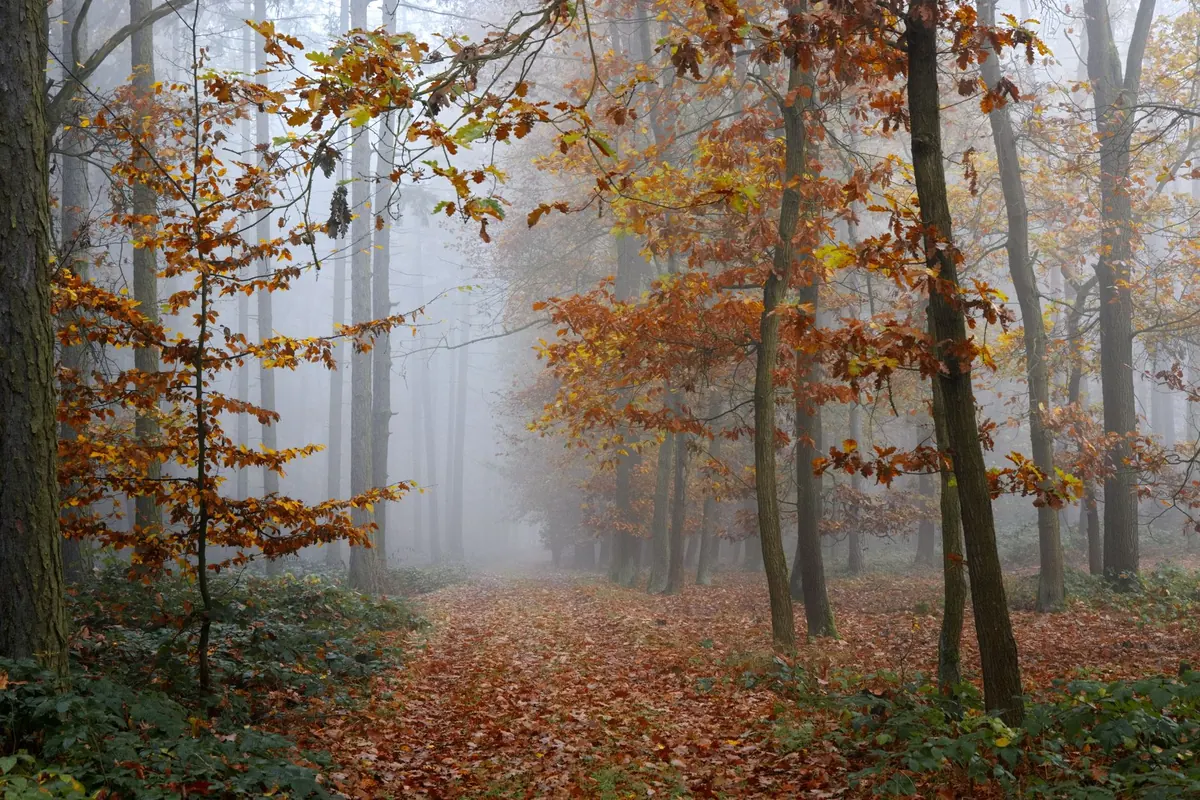
Mist is a gift for anyone stuck creatively, because it edits the world for you, leaving silhouettes and layers. On wet days colours deepen and saturate; a walk in drizzle will show you reds and yellows that vanish the moment the sun comes out.
Prompt: before you go home, write down the exact colour of the sky and the exact sound of the ground under your feet.
Turn the Walk Into Material
Nothing you notice is much use until it is recorded. Keep the system small enough that you will actually keep it up. A pocket notebook and a pencil is the classic answer, but a voice note on the walk home works just as well.
Three lines per walk is enough: one colour, one texture, one sound, written in plain, specific language. Add the date and the weather. Once a week, sit down for five minutes and turn those notes into something — a paragraph, a sketch, a colour chart, a list of words you could use in a song. On the days when you feel flat and uninspired, those notes become the thing you work from instead of waiting for an idea to arrive.
Keeping It Going Through the Season
Aim for twenty minutes, three times a week, on the same route. Take a notebook small enough to fit in a coat pocket, and a pencil rather than a pen, since it will survive rain better. Wear shoes you don't mind getting muddy, and go out even when the weather is dull, because dull weather is often when the detail shows up.
At the end of November, read back through everything you collected and pull out the ten details you like most. That short list is your autumn's worth of raw material, and it will keep you working well into the grey weeks of January.
Walking is good for mood as well as for ideas, but it is not a substitute for support. If low mood is lasting more than a couple of weeks or affecting daily life, speak to your GP or another qualified professional.
Photo: Karel Drozda / Pexels
Related posts
More stories you’ll love reading