



Most evening routines fail for a predictable reason: they're designed for the person you'd like to be at ten o'clock, not the one who actually turns up. Ten steps, an elaborate ritual, a journal with a ribbon bookmark — and by Wednesday it's abandoned. The version that lasts is smaller and kinder. It leans on four things that genuinely shape sleep: light, temperature, what you write down, and where your phone lives. Get those roughly right and the rest is decoration. It also leaves more room for ideas, because a settled mind notices things a wired one misses.
Start With the Hour, Not the List
Don't begin with what you'll do. Begin with when the wind-down starts, then work backwards from your alarm. If you're up at seven and you want eight hours in bed, the wind-down should be underway by ten. Choose a time you could hit on an average Tuesday, not a perfect one.
Set a second alarm for it, labelled plainly — something like "start slowing down". A reminder that arrives at the same time each evening does more for your rhythm than any sleep app.
The aim is a ramp, not a switch. Forty-five minutes of gradually dimming and slowing is easier to keep than a sudden blackout at eleven. If ten o'clock sounds absurdly early, start with a fifteen-minute warning at ten and a real wind-down at ten-thirty. You can always move it earlier once the habit holds.
Think of it as a runway, not a runway show. You're not performing calm; you're giving your nervous system a series of small, repeated signals that the day is ending. The same lamp, the same playlist, the same mug of tea can do more than a perfect routine you follow once.
Light Is the Strongest Signal You Send
Your body reads light as a clock. Bright light late in the evening says daytime; dim, warm light says the day is closing. That makes overhead lighting the most useful thing to change first.
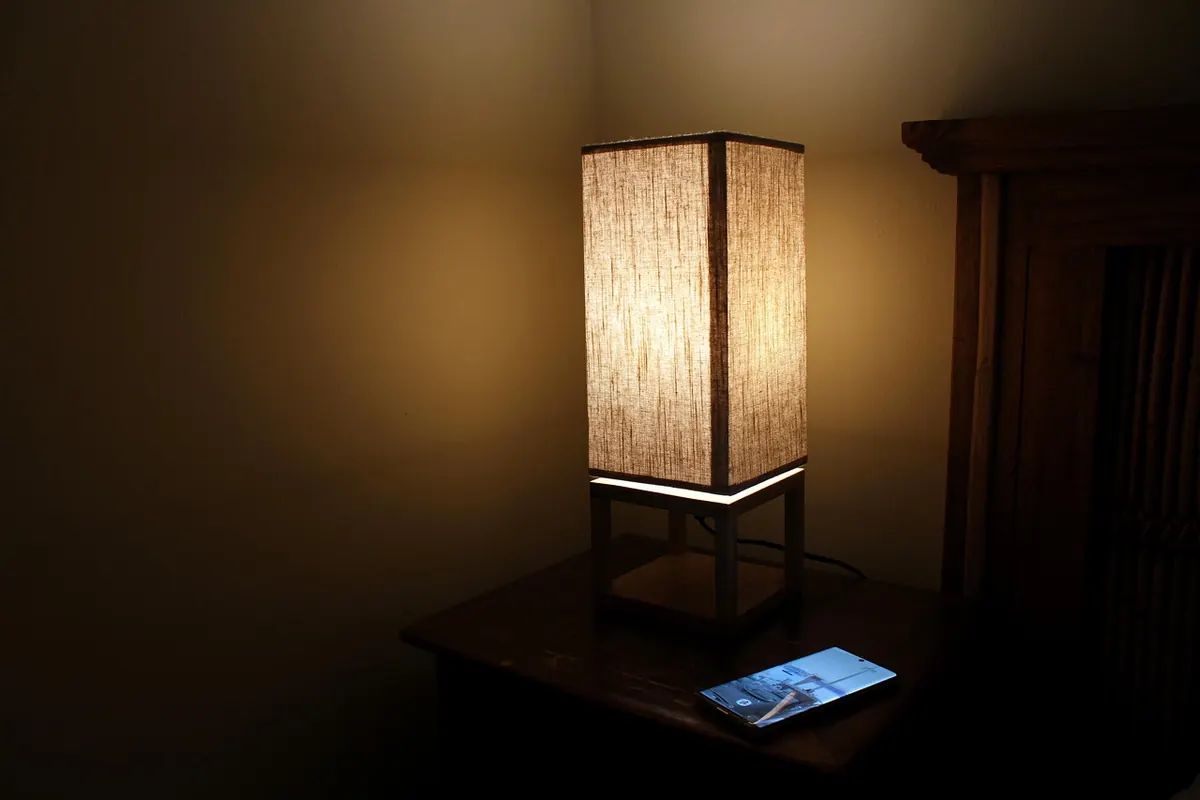
Swap the ceiling light for lamps, ideally at hip or knee height rather than eye level. Choose warm white bulbs, fit a dimmer if you have one, and if you read on a screen, drop the brightness and enlarge the text. A small lamp with a fabric shade can make a living room feel like a different room entirely.
Mornings matter as much as evenings. Daylight within the first hour of waking — a short walk, breakfast by a window — anchors the pattern you're building at night. If you can't get outside, sit facing a window while you drink your coffee. The contrast between bright morning and dim evening is what makes the signal clear.
Cool the Room, Warm the Body
Body temperature falls as you approach sleep, and a warm shower or bath about an hour before bed nudges that along: you heat up, then cool down, and the cooling is what feels drowsy. A hot bath ten minutes before you get in is less reliable; you arrive too warm.
Keep the bedroom cooler than the rest of the house — many people sleep best in the mid-to-high teens Celsius, though comfort matters more than a number. Let air move: a window cracked for ten minutes, or a fan on its lowest setting.
If you're cold, warm your feet rather than the whole room. Socks, a hot water bottle at the foot of the bed, a lighter duvet. The goal is a body that's warm enough to relax and a room that's cool enough to sleep.
Make Screens Slightly Inconvenient
Rules that depend on willpower collapse at night. Friction works better.
- Charge your phone outside the bedroom — kitchen, hallway, anywhere you'd have to stand up to reach it.
- Buy a cheap alarm clock so your phone doesn't have to be your wake-up call.
- Switch on Do Not Disturb from your wind-down time, and tell the people who might need you to call twice if it's urgent.
- If you want to watch something, use the biggest screen you have, then leave the small one behind.
None of this has to be absolute. A phone across the room beats a phone in your hand; a phone in your hand at nine beats one in your hand at midnight. If you live with other people, make it a shared norm rather than a personal rule. It's easier to leave your phone in the kitchen when everyone else does too.
Write It Down So You Can Put It Down
Night-time journaling works best when it empties the day rather than fills it. You're not there to produce insight. You're there to stop carrying open loops into bed.
The two-minute brain dump
List everything unfinished: the email, the dentist, the thing you said in a meeting. Don't solve any of it. Add one line at the bottom — anything on this page can wait until morning — and close the book.
The idea parking pad
Creative work doesn't respect office hours; ideas often arrive just as you lie down. Keep a notebook by the bed and give an idea two lines. You're not abandoning it, you're filing it somewhere you'll find it at breakfast. That's the difference between a thought that keeps you awake and a note you can act on tomorrow.
If you like a bit of structure, three prompts are plenty:
- What's still open from today?
- What's the first thing I'll do tomorrow?
- What was good today, however small?
A Routine You Can Fit Together
Here's a version that takes about forty minutes. Shift the times to suit your evening.
- Dim the lights, draw the curtains, put the phone on charge in another room. Four minutes.
- Shower or wash — warm, not scalding — then let the bedroom cool while you dry off. Ten minutes.
- Make a cup of herbal tea or a glass of water. Sit somewhere comfortable and do the brain dump or read a few pages of fiction. Fifteen minutes.
- Set out tomorrow's first small task: clothes, coffee mug, the document you'll open first. Five minutes.
- Get into bed before you're exhausted. Lights out. If your mind starts rehearsing tomorrow, put a hand on your belly and count five slow breaths. One minute.
Notice what isn't on the list: no perfect sequence, no special equipment, no requirement to feel serene. The routine is a set of cues, not a test. If you only manage the lights and the phone, you've still done the two most important things.
What to Do When the Routine Breaks
You will miss nights. You'll work late, travel, get sick, or simply forget. The mistake is treating one broken evening as proof that the whole thing doesn't work. A gentle routine is designed to be resumed, not never interrupted.
- If you're wired at bedtime: don't lie there negotiating. Get up, sit in dim light, and write down what's circling. Return to bed when you feel drowsy, not when the clock says you should.
- If you wake at 3 a.m.: keep the lights off, avoid checking the time, and try the same slow breathing. If sleep doesn't come in twenty minutes, read something dull by a small lamp until your eyelids get heavy.
- If you're travelling: pack an eye mask, keep the phone out of reach, and do a two-minute brain dump on hotel stationery. The cues can be portable.
- If you've abandoned it for a week: restart with just one piece — the alarm, the lamp, or the phone charging outside the bedroom. One cue is enough to rebuild the rest.
Why This Helps Creativity, Not Just Sleep
A settled mind is an associative mind. When you're not braced against the next alert or replaying an argument, your brain has more room to make unusual connections — the kind that turn into ideas the next morning. That's not magic; it's just what happens when you stop flooding your system with light, information, and unfinished tasks.
Many writers and artists deliberately leave a problem half-solved before bed. They read it once, close the notebook, and let sleep do the sorting. You can do the same with the idea parking pad: write the question, not the answer. In the morning, you may find that the first line you write is better than anything you'd have forced out at midnight.
Sleep is not the opposite of creative work. It's part of the work — the quiet shift where your brain files, connects, and rehearses without your supervision.
The routine itself also protects creative time. If you know the evening will end gently, you're less likely to cram every last task into it. You might even leave a sentence unfinished on purpose, so you have somewhere to begin tomorrow.
Keep It Small Enough to Keep
The best evening routine is the one that survives a bad day. It should be boring in the best sense: predictable, low-effort, and easy to start even when you're tired. If a step feels like homework, cut it in half. If a rule makes you rebel, soften it. If you miss a night, begin again the next evening without a lecture.
Start tonight with one change. Put the phone in another room, lower the lights, or set that second alarm. Then let the rest of the routine grow around it, slowly, until it feels less like a discipline and more like the natural shape of your evening.
Photo: ianvanderlinde / Pixabay
Related posts
More stories you’ll love reading